|
1
|
- Peter Koletzke
- Technical Director &
Principal Instructor
|
|
2
|
- JDeveloper and ADF
- JSF and ADF Faces
- JHeadstart
- Is it Oracle Forms Yet?
|
|
3
|
- Oracle’s Java IDE
- 3GL code generator and organizer
- Some 4GL aspects
- Supports all development for J2EE
- Different styles of deployment
- E.g., Java application, applet, JSP, servlet, EJB
- Easy development, debugging, deployment
- Lots of wizards that create starting code
- Data access framework: Business Components (BC4J and ADF BC)
- Work in JDeveloper is oriented around
ADF
|
|
4
|
- A meta-framework: a wrapper for other frameworks
- JSF
- Struts
- ADF Business Components, etc.
- Meets the challenges of J2EE development
- Lots of technology choices
- No tool to integrate them
- Database connectivity is difficult (JDBC)
- Available starting in JDeveloper 10g
- Multiple development paths use same
code layers
- Based on Model-View-Controller
J2EE design pattern
|
|
5
|
|
|
6
|
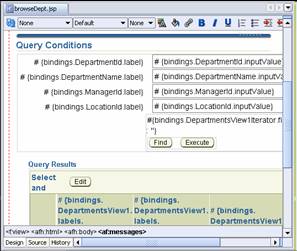
- Primarily visual and declarative
|
|
7
|
- Create application workspace
- Create Business Services and Model project
- Create View and Controller project
- Add Model objects using the BC diagram,
wizards, and editors
- Add View and Controller objects
- Create navigation diagram then pages
- AND/OR
- Create pages then navigation diagram
- Test and debug
|
|
8
|
- JDeveloper and ADF
- JSF and ADF Faces
- JHeadstart
- Is it Oracle Forms Yet?
|
|
9
|
- JavaServer Faces technology
- “New” technology (ratified JCP in 5/2004)
- Part of the new Java Platform spec (Java EE 5)
- Offers reference implementation
- Effort to simplify JSP development
- Component-ize it
- High-level components provide much functionality
- Integrate the controller
- Write less HTML
- Component handles markup language
- Can embed JSF in a JSP page
- Reference Implementation only supports JSP
- Outputs HTML to the browser
|
|
10
|
- <af:panelButtonBar
-
binding="#{backing_Deptapp.panelButtonBar1}">
- <af:commandButton
-
actionListener="#{bindings.First.invoke}"
- action="First"
text="First"
-
disabled="#{!bindings.First.enabled}"
-
binding="#{backing_Deptapp.commandButton1}"/>
- <af:commandButton
-
actionListener="#{bindings.Previous.invoke}"
- action="Previous"
text="Previous"
-
disabled="#{!bindings.Previous.enabled}"
-
binding="#{backing_Deptapp.commandButton2}"/>
- </af:panelButtonBar>
|
|
11
|
- Oracle tag libraries
- Released to MyFaces open source project in Jan. 2006
- Trinidad project at myfaces.apache.org
- Available in JDeveloper 10.1.3
- Over 100 components
- Implements most components available in UIX
- UIX is used by Oracle E-Business Suite apps
- Uses JSF mechanisms
- Adds even more functionality to JSF
- Lots of additional features
- Important: Oracle is using ADF
Faces to build Fusion applications
|
|
12
|
- Supports multiple platforms through “render kits”
- Theoretically, so does native JSF
- JSP document or page (for HTML clients)
- Telnet
- Wireless
- Changeable “skins”
- Look-and-feel characteristics
- oracle, minimal, simple, your own
- Can be changed with one config property
- Solid development support in JDeveloper
- Dynamic images
- Tab and button images are
generated at runtime
- Text on image is based on
properties
- No maintenance of image files
|
|
13
|
- Partial page rendering (PPR)
- Only part of page is submitted
- For example, only table values are refreshed
- This makes the user experience smoother
- Available on several components
- JavaScript effects without
JavaScript coding
- AJAX-like
- Asynchronous JavaScript and XML
- Industry-standard method
- Very hot currently
|
|
14
|
|
|
15
|
|
|
16
|
- JDeveloper and ADF
- JSF and ADF Faces
- JHeadstart
- Is it Oracle Forms Yet?
|
|
17
|
- Oracle product
- Developed by Oracle Consulting’s Center of Excellence in the
Netherlands
- Google “JHeadstart Product Center”
- Limited trial version available for download
- Add-in for JDeveloper
- In sync with version 10.1.3.2
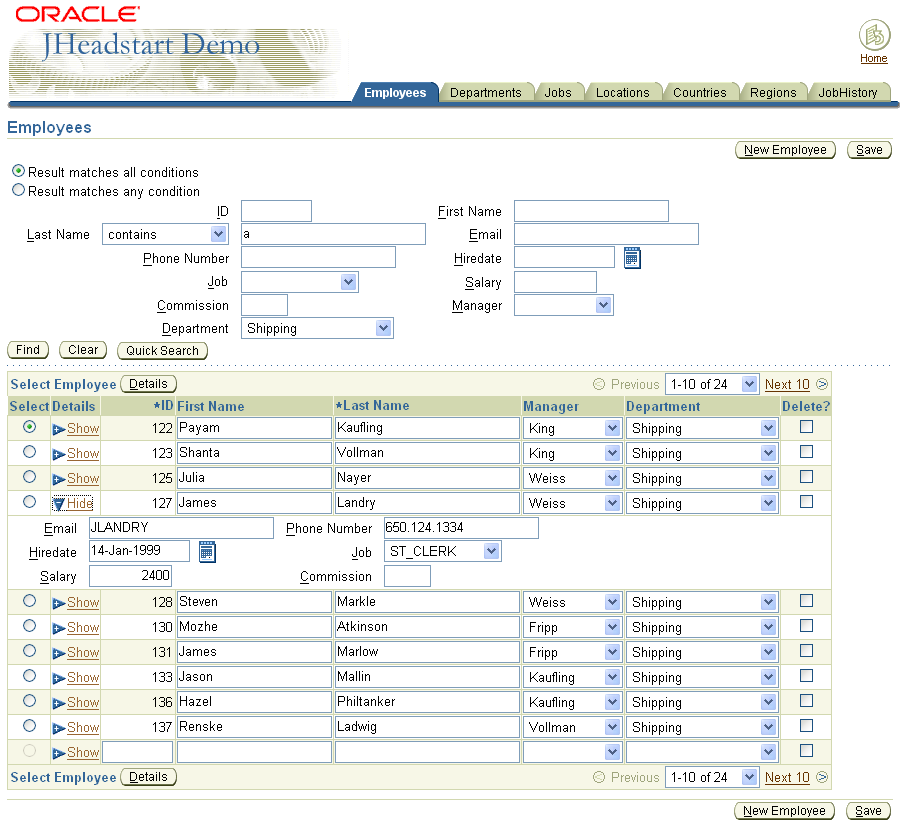
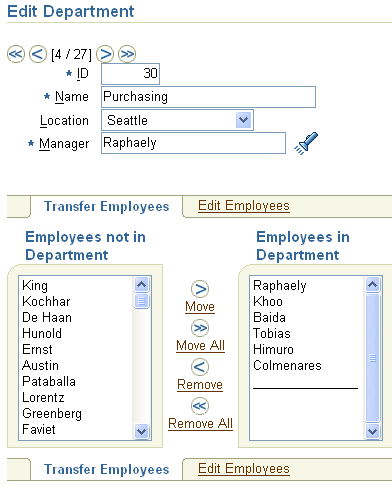
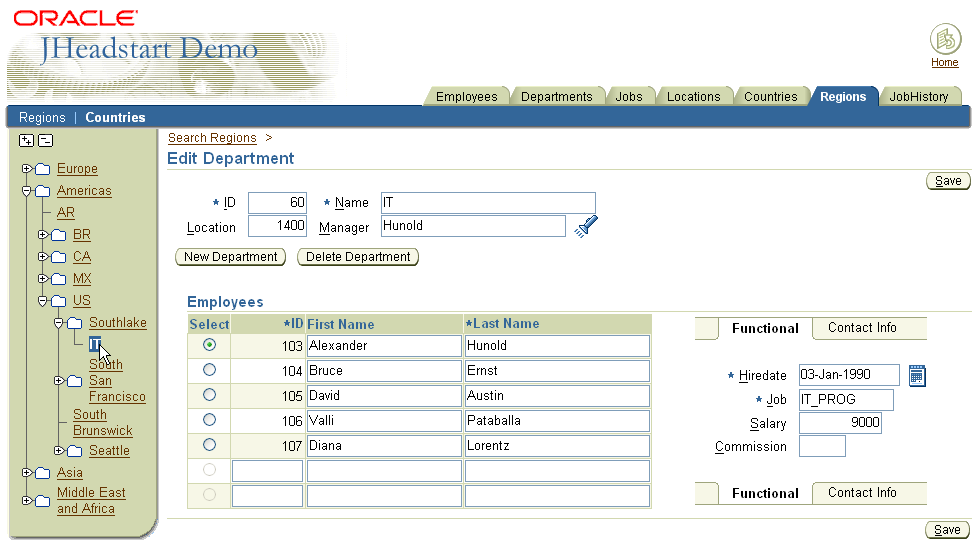
- Contains JHeadstart Application Generator
- Generates ADF Faces and JSF code from definitions in the application
definition file
- Fully template-driven
- Modify the generated code using
standard JDeveloper techniques
- Contains JHeadstart Designer
Generator – migrate Designer definitions
|
|
18
|
|
|
19
|
|
|
20
|
|
|
21
|
- JDeveloper and ADF
- JSF and ADF Faces
- JHeadstart
- Is it Oracle Forms Yet?
|
|
22
|
|
|
23
|
- RAD for standard operations
- RAD for complex functions
- Forms slightly ahead of JDeveloper without JHeadstart
- JDeveloper with JHeadstart is way ahead of Forms
- Development complexity
- Forms developers face a learning curve with JDeveloper
- With JHeadstart the learning curve is much less
- Ease of extensions
- ADF Faces - 3GL is always present
- Forms needs Java (PJCs)
- Highly interactive UI – Forms
- Apples and oranges (light client vs. heavy client)
- ADF Faces and JHeadstart generated code is very interactive
|
|
24
|
- Prebuilt components – ADF Faces
- Forms has 22 (8 of which are drawing shapes)
- ADF Faces has over 100 (some are not visual)
- Development experience
- Forms = declarative and visual with some PL/SQL
- ADF Faces = declarative and visual with some Java (and Expression
Language)
- JHeadstart = declarative only
- Future
- Forms’ future is solid – support to 2012
- Functionally stable, no new features
- Still part of Oracle Applications (E-Business Suite)
- ADF Faces – very new technology
- Nothing in J2EE lasts very long
- J2EE is Oracle’s focus
- JHeadstart
- Has rapidly growing following
- Makes sense for Forms developers
|
|
25
|
- JDeveloper is a J2EE tool
- Supports any style of J2EE code
- Less need to think about “plumbing”
- Before ADF Faces, little guidance for suggested path
- “Productivity with
Choice”
- The myth for Forms
developers
- How to choose?
|
|
26
|
- Language skills needed
- Java is omnipresent
- But only at a scripting level
- Still need a Java architect on the project
- XML is a handy skill
- If you know “elements” and “attributes,”
that’s enough
- HTML is not really used in ADF Faces
- Helps to know what an HTML table is
- ADF development method
|
|
27
|
- It can help shops that have J2EE experts
- J2EE experts will be more productive
- They need to learn the ADF process
- It can also help shops who have “traditional” non-J2EE Oracle developers
- Forms and PL/SQL developers can
be
productive with the declarative tools
- With training, they can write Java extensions
- Much of the complexity is hidden
- They need a J2EE expert to guide them
and code the internal, complex stuff
|
|
28
|
- ADF is a framework in JDeveloper that helps development productivity
- You can create J2EE web applications with JSF and ADF Faces
- JHeadstart provides lots of prebuilt, working code you can use as a
starting point
- JDeveloper development is close to Forms development
- Rivals Forms’ productivity
- Extremely rich component set
- Support for declarative and visual programming
- Requires a bit of ramp up time
- It’s J2EE-compliant and you still
need a J2EE architect
|
|
29
|
|

 Notes
Notes