|
1
|
- ..., make known to them the design of the temple --its arrangement, its
exists and entrances-- its whole design and all its regulations and
laws. Write these down before them so they may be faithful to its design
and follow all its regulations.
- Ezekiel 43:11
|
|
2
|
- This language:
- Is a simplified version of a literate language. It lets organize the
business’ knowledge in a textual manner, with subtle syntax impositions
- allows to obtain units of specification code that are between the
IMPLEMENTATION CODE and the BR DECLARATION
- Is oriented to specify Business Rules (BR), the Transformations and the
Life Cycle of an Entity
|
|
3
|
- A Business Rule contains three
kinds of knowledge:
- Actions, that refer to the knowledge of ‘How’ to do something
- Decisions, that relate to the knowledge of ‘When’ the actions will be
applied
- Entities, that identify to ‘Whom’ the actions and decisions will affect
and will be applied to
- According to the hierarchy of
execution and application, the BR have been classified in high, top,
middle and low level rules
|
|
4
|
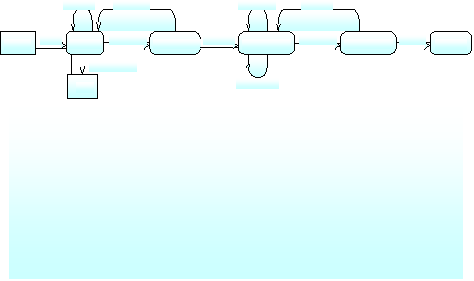
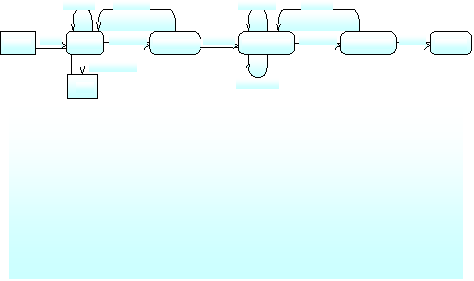
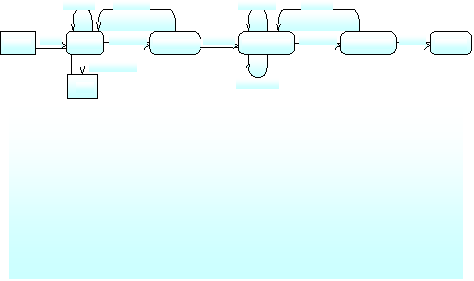
- It is a model that defines the
entity’s behaviour, since it is created until it is removed
definitively. This model is described as a states machine, extended to represent different types
of Business Rules
- States are rules that define the moments in which an entity will be
transformed in other one
- Transformations are rules that define the most important events that
might occur over an entity
- Transitions are rules that prevent improperly usage of the
transformations over an entity.
|
|
5
|
- It uses five tags for
remarking
- It has three sentences
- It intermingles text among the
tags
- This language, with the tags,
is trying to encapsulate and hide the specific knowledge, nevertheless,
with the text, it is trying to clarify the pinpoints made with the tags
|
|
6
|
- ( ) Directive tag is used to point out
the decision criteria and condition rules. The & operator is used
for joining decision criteria
|
|
7
|
- < > Rule Tag is taken into account to
emphasize actions and determinations
|
|
8
|
- { } Pattern tag is used to arrange other
tags including itself within valid rule chunks
|
|
9
|
|
|
10
|
|
|
11
|
- In relation to a table, it
lets define: the records’ states;
the table’s transformations; the transition constraints and the
default rules
|
|
12
|
- Lets program the top level
rules to be applied over a table’s records
|
|
13
|
- Lets organize the knowledge
(actions and decision structure) implied in a rule
|
|
14
|
- lifecycle BANK_ACCOUNTS {
- (TYPE_OF_RULE)
- [STATES] {
- <OPENED, ‘The Account is
empty and recently created’>
- <PREPARED, ‘The Account
is prepared for entering in operation’>
- <OPERATING, ‘The Account
is operating’>
- <SUSPENDED, ‘The Account
is out of operation’>
- <CLOSED, ‘The Account is
closed’>
- }
|
|
15
|
- [TRANSFORMATIONS] {
- <OPEN, ‘Create a new
account’, INSERT>
- <MODIFY, ‘Modify a new
account’, UPDATE>
- <ELIMINATE, ‘Delete a new
account definitively’, DELETE>
- <PREPARE, ‘Prepare for
entering a new account ...’, UPDATE>
- <RESTORE, ‘Restore the
account preparation’, UPDATE>
- <ENABLE, ‘Enable a
prepared account for operating’, UPDATE>
- <DEPOSIT, ‘Propagate the
deposits to an operating ...’, UPDATE>
- <WITHDRAW, ‘Propagate the
withdrawals to an ...’, UPDATE>
- <SUSPEND, ‘Suspend an
operating account’, UPDATE>
- <RESUME, ‘Resume a
suspended account’, UPDATE>
- <CLOSE, ‘Close a
suspended account’, UPDATE>
- }
|
|
16
|
- [TRANSITIONS] {
- <START, OPEN, OPENED>
- <OPENED, MODIFY,
OPENED>
- <OPENED, PREPARE,
PREPARED>
- <PREPARED, UNPREPARED,
OPENED>
- <PREPARED, RESTORE,
OPERATING>
- <OPERATING, DEPOSIT,
OPERATING>
- <OPERATING, WITHDRAW,
OPERATING>
- <OPERATING, SUSPEND,
SUSPENDED>
- <SUSPEND, RESUME,
OPERATING>
- <SUSPEND, CLOSE,
CLOSED>
- <OPENED, ELIMINATE,
END>
- }
- [DEFAULT RULES] {
- <control the permissions
and register audit information>
- }
- }
|
|
17
|
|
|
18
|
- rule (the information of the owner of the account has been changed) {
- (the first name is changed)
<return TRUE>
- (the last name is changed)
<return TRUE>
- (the telephone number is
changed) <return TRUE>
- <return FALSE>\
- }
|
|
19
|
- transformation WITHDRAW {
- When withdrawing a certain
amount of money from an account, the
- following BEFORE ROW and AFTER
STATEMENTS actions or controls must
- take place according to the
(MOMENT & LEVEL):
- when it is [BEFORE ROW] then,
the engine must: {
- <check the user’s
permission over transformation>,
- <check the
transformation’s permissions for changing the ...>,
- <validate the column’s
values> and
- <deduct the quantity
withdrawn from the account’s balance>
- };
- finally, when it is [AFTER
STATEMENT] then, the engine must {
- <save audit information
at record level>
- }.
- }
|
|
20
|
- This machine supports
creation, modification and elimination events. Each one of them
transform an entity from current state to another state individually or
collectively.
- This machine works as a control and application mechanism of BR. It is
in charge of constraining the inappropriate application of the
transformations through a state control mechanism.
|
|
21
|
|
|
22
|
- The documentation is based on
the rule, transformation and lifecycle sentence of this language
- The language’s compiler lets
obtain and store enough information for generating any kind of
documentation
|
|
23
|
- The information obtained from
lifecycle, transformation and rule sentence is stored in the next table
scheme
|
|
24
|
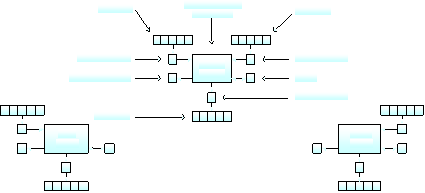
- It is based on the Language’s
Abstract Machine which is implemented as:
- Twelve triggers by which the insert, update and delete events are
implemented
- A control package in which the state control mechanism are defined
- A PL/SQL table by which the machine’s tapes defined in the control
package is implemented
|
|
25
|
- The BR are implemented as:
- BR packages, in which the top, middle and low level rules
procedures/functions are defined
- Database tables, where the transitions constraints are stored for
enacting in runtime
- Procedures, by which each transformation declared in the control
package are implemented
|
|
26
|
- In our case the development
methodology has been changed
- the applications have to be thought in terms of BR
- the analysts and business rule experts are and will be more involved
in the development and maintenance of BR specifications
- The language lets implement
many types of BR
- Some problems gain importance
- the generation of the specific PL/SQL code for low level BR
- the dynamic on/off switching of the BR
- the BR that affect recurrently a table
|
|
27
|
- Contact Information
- e-mail: Home :
atorrezgaray@hotmail.com
- Work : atorrez@ilaco.gov.bo
- phone: Office : (591-2)
200822
- Cell : (591-15) 57322
|

 Notes
Notes